Beyond the Case: Building a Consulting Career in the Age of AI

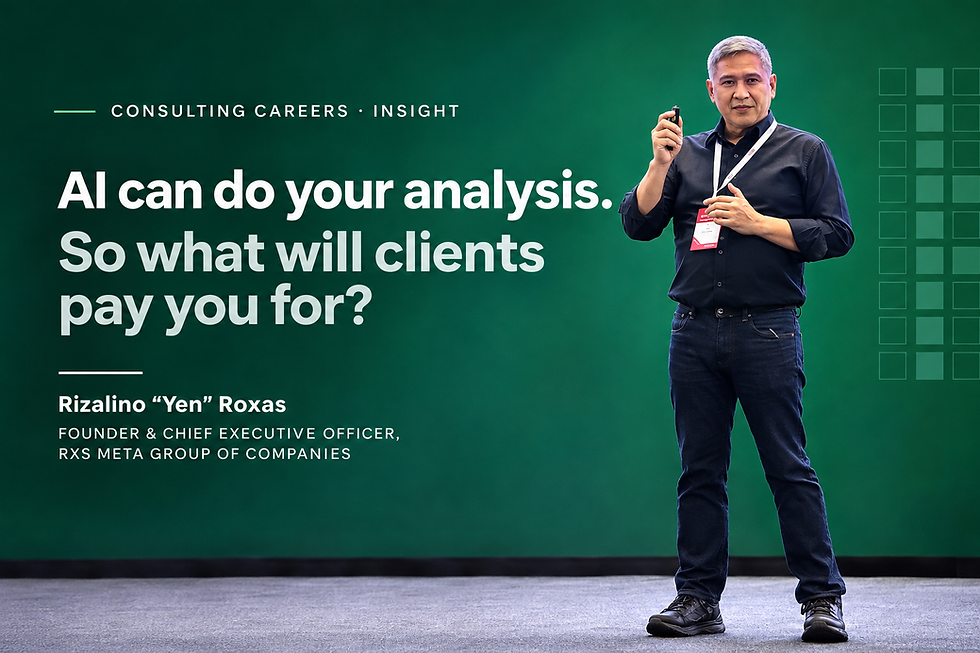
Much of the analysis you are training to do, AI can now produce in a fraction of the time.
So what will a client pay you for?
If you are a student planning a career in consulting, that is the question worth sitting with before you graduate. Not because the profession is disappearing, but because what it rewards is changing faster than most curricula. My answer, from both sides of the table, is simple: when analysis becomes a commodity, judgment becomes the product.
Twenty-nine years as the client
For 29 years at Chevron, across 13 roles in the Philippines and Asia Pacific, I sat on the client side. Strategy, marketing and operations. We hired consultants, briefed them, and lived with their recommendations long after their teams had rolled off.
In 2024, I founded Roxas Management Consultancy, now part of RXS Meta Group. Today I sit on the other side of the table, bringing advisory and enterprise technology to boards, government institutions and global partners.
That vantage point matters. Most career advice about consulting comes from consultants. What follows comes from someone who spent three decades deciding which consultants were worth paying, and which were worth calling back.
What AI changed, and what it did not
AI has moved squarely into the work junior consultants were traditionally hired to do. That is not a threat to manage. It is a fact to plan around.
Accelerated by AI | Still owned by the consultant |
Desk research and synthesis | Deciding which question is worth answering |
Data cleaning, modelling and charts | Judging whether the numbers make sense |
First drafts of decks and memos | Knowing what this client can hear today |
Applying standard frameworks | Recommending, and standing behind it |
Read the right-hand column carefully. Every item on it requires context, nerve or accountability. None of it can be prompted into existence. That column is your career.
What clients actually buy
I worked with many consulting teams over three decades. Only a few I still remember. None of them stood out for the polish of their slides. They stood out for two behaviours.
The third was the one I almost never saw.
They asked a better question. Before answering mine, they checked whether I was solving the right problem. More than once, that question saved a project before it started.
They told me the hard thing. Early, plainly and in private, before it surfaced in front of my leadership. That took courage, and it earned trust I extended for years.
They did not stay for the result. In my experience, consultants rarely did. Most teams rolled off at sign-off, measured by whether the recommendation was accepted, not whether it worked. The implementation, and its consequences, stayed with us. That gap is where the next generation of consultants can set itself apart: treat the sign-off as the start of your accountability, not the end of it.
Clients rarely pay for analysis. They pay for someone willing to own the answer.
Four skills beyond the case
Case competitions teach structure. A career demands four further skills, and you can start building each of them now.
Judgment. Knowing which question matters, and recognising when the data is misleading you.
Client trust. Earning the right to say the hard thing, and being believed when you do.
Synthesis into a decision. One page, one recommendation, one clear ask of the client.
Responsibility. Owning the consequences for every person your recommendation touches: employees, customers and communities, not only the executive who signed the engagement.
Leading with AI and purpose
You will spend much of your early career recommending technology. Here is the standard I hold my own firm to: adoption is not the achievement. Adoption that a board can defend is.
Before recommending any AI solution, ask four questions:
Who is accountable when it is wrong?
What outcome will we measure, agreed before launch?
Who is affected, inside and outside the organization?
Would this survive being read aloud to the board?
If you cannot answer all four, you are not ready to recommend. The consultants who ask these questions first will be the ones boards trust with the decisions that matter.
From student to consultant: what changes
The shift from student work to client work is larger than most graduates expect. The stakes move from your grade to someone else's livelihood.
As a student consultant | As a professional |
The answer is graded | The answer is implemented |
The case ends at the recommendation | The work ends at a measured result |
A panel of judges hears you | The client lives with your decision |
Data arrives clean | Data arrives late, partial and political |
You defend your logic | You earn the client's trust |
Five things to start this semester
You do not need a job offer to begin practising. Start with these.
Use AI every day, and check every answer it gives you. Fluency with the tool is table stakes. Scepticism toward it is the differentiator.
Treat each engagement as a mandate. Agree the outcome measure up front, even on a class project.
Practise the conversation. Present your work to a sceptic, not a friend.
Learn one industry from the inside. Visit the plant, the branch, the warehouse. Credibility is built where the work happens.
Keep a judgment journal. Write down your call before the data comes in, then check it. Over time, you will learn where your instincts are reliable and where they are not.
Three lessons from my own journey
Learn the operation before you advise on it.
My credibility came from having run marketing operations across Asia Pacific, not from describing them. Clients can tell the difference within minutes.
Relationships compound.
The people you serve well become the people who call you back, sometimes decades later. Many of the doors RXS Meta walks through today were opened by relationships built in my Chevron years.
Your first career is preparation for the next.
I founded RXS Meta in 2024, after 29 years and 13 different roles in one company. Nothing was wasted. Every role, including the ones I did not choose, became part of what I bring to clients now.
The case and the career
The case teaches you to find the answer. Your career will ask you to own it.
AI will make you faster.
Only judgment, trust and responsibility will make you valuable. Build those deliberately, starting now, and you will not be competing with the machine. You will be the person clients call when the machine's answer is not enough.
#consultingph #philippines #aiph #futureofwork #leadership #consulting #careeradvice #artificialintelligence