History doesn't repeat itself. But it rhymes loudly when you understand the system beneath it.

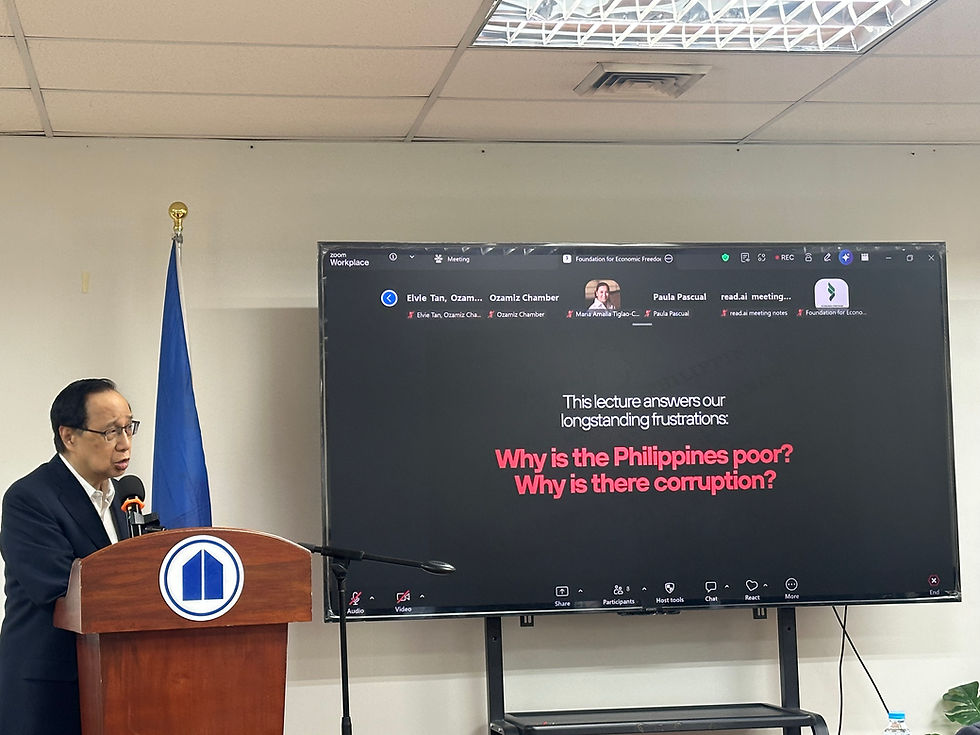
This afternoon at the Philippine Chamber of Commerce Inc HQ, economist Calixto Chikiamco, Jr. of the Foundation for Economic Freedom walked a room of business leaders through 80 years of Philippine path dependence.
From the Bell Trade Act of 1946 to the de-industrialization charts of 2024. From Manila as the Pearl of the Orient to the most concentrated economy in Asia.
Slide by slide. Decade by decade. Crisis by crisis.
One image stopped the room: Manila in the 1950s next to Seoul in the 1950s. Manila was modern, prosperous, unmistakably ahead. Seoul looked like a provincial market town.
Today, South Korea is the 13th largest economy in the world. The Korean Won trades at 1,389 to 1 USD, deliberately devalued to build export competitiveness. The Philippine Peso was frozen at PHP 2 to USD 1 by the Bell Trade Act, unable to adjust without approval from the US President.
That single policy decision, compounded over eight decades, changed everything.
The lecture didn't spare anyone. The EDSA revolution framed not as liberation but as restoration. A strange bedfellows coalition: the anti-Marcos oligarchy, the Catholic Church, left-of-center elements, and 25,000 CPP-NPA armed rebels. A temporary alliance with no shared economic vision.
What followed was the 1987 Constitution - well-intentioned, but structurally catastrophic in three ways:
→ Filipino First provisions produced the most concentrated economy in Asia - monopolies and oligopolies where competition should have been.
→ The Comprehensive Agrarian Reform Program reduced average farm size by 34% and productivity by 17%. Land reform that made an inefficient government the landlord.
→ Labor rigidities drove light manufacturing to Vietnam and Bangladesh - despite 20 to 25% unemployment and underemployment at home. Monopolists didn't mind. They were extracting rent, not competing.
The pattern across every decade is the same: when reform threatens rent-seekers, the system adapts to protect them. When globalization arrived in the 1990s and tariffs fell, the oligarchy simply pivoted to non-tradeable services - banking, telecoms, power distribution, shipping, PPPs with government.
The game changed. The players didn't.
Dr. Raul Fabella's line from the slides has stayed with me:
"In the Philippines, the rules themselves are for sale."
That is not a political statement. That is a structural diagnosis. And it explains why each wave of reform, EDSA, the 1987 Constitution, globalization - produced the same result: concentrated power, fragile growth, and institutions that extract rather than enable.
In the open forum, I have three arguments - not as commentary, but as an operator committed to making things happen:
First: AI-driven governance breaks the opacity that protects rent-seekers. Audit trails, automated procurement, real-time budget transparency - these are not technology investments. They are institutional integrity investments. They change what the system can hide. We are working to deploy these today - not in pilots, in national institutions.
Second: ESG is an incentive redesign tool, not a compliance exercise. The reason rent-seeking became rational is that the system rewarded it. ESG frameworks - properly embedded, not just reported shift what the system rewards. Stewardship becomes more profitable than extraction. That is the structural intervention.
Third: The private sector cannot wait. The manufacturing share of our GDP continues to shrink - lowest among ASEAN peers. Manufacturing drives labor productivity, which drives wages, which drives poverty reduction.
That chain is broken. We in the private sector are in a position to rebuild it through AI-driven operations, ESG-aligned governance, and the political will to demand institutions that work.
29 years inside one of the world's most governance-intensive multinationals taught me one thing above all: transformation is not an event. It is a series of deliberate operational decisions made by people willing to be accountable for outcomes.
EDSA was a moment. What we need now is not another moment - it is sustained operational commitment from institutions and leaders who refuse to let the system adapt around them.
The tools exist. The frameworks are deployable. The partners are ready. And we are in a position to make it real - one institution, one deployment, one committed leader at a time.
The Sick Man trap was built by decisions. It will be dismantled by decisions.
That work starts now.