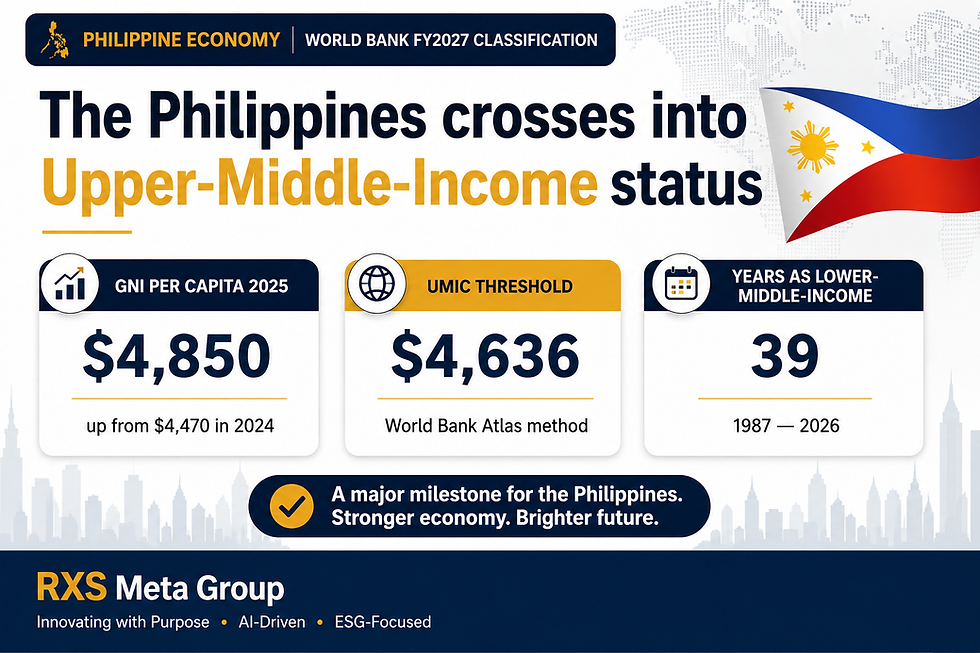
The Philippines crosses into Upper-Middle-Income Status

The Philippines just crossed a threshold three decades in the making.
GNI per capita: $4,850. The World Bank's upper-middle-income line: $4,636.
After 39 years as a lower-middle-income economy, we're officially in a new category.
The numbers behind it are real. GDP growth averaging 5.8% a year since 2021. Broad-based - not one sector carrying the rest, but gains across industries. That's the kind of growth that's harder to engineer and more durable when you get it.
But I've spent more than 3 decades 29 years across the Philippines and Asia Pacific, and one thing that career taught me: an average is not a distribution. GNI per capita includes OFW remittances - Filipinos working abroad are part of why we crossed the line. Inflation is still running above target.
Underemployment is climbing, not falling. NCR and Bangsamoro are not living the same economy.
So here's how I read this milestone: it's a credential, not a conclusion. It changes how the world prices our risk and our potential. It does not yet change what a family in Zamboanga feels at the sari-sari store.
This is exactly the gap RXS Meta Group was built to close. Our thesis is innovating with purpose : AI-driven, ESG-focused, built for institutions that serve the public, not just the balance sheet. Emergency response infrastructure. Institutional knowledge systems for agencies that touch millions of citizens daily. Field-force and logistics visibility for organizations operating outside Metro Manila. Governance frameworks that keep AI adoption accountable to the communities it's meant to serve.
Macro credibility only becomes inclusive opportunity when someone does the unglamorous work of deploying it at the point of service delivery - that's the mandate we operate under.
The organizations that win from here are the ones that treat this upgrade as a mandate - to convert macro credibility into inclusive, on-the-ground opportunity, not as a victory lap.
That's the work. Reclassification was the easy part.
Where do you think the real test starts - investment quality, job creation, or regional distribution?